Why the first version should be small and fast
The expensive mistake in early product work is not building the wrong feature — it is building twenty of them before anyone has paid you. Every month spent in private polishes assumptions nobody has tested. An MVP exists to answer one question: will the people you are targeting actually use this and pay for it? Ship the shortest path to that answer, then let real behaviour decide what gets built next.
Speed also determines your options. A working product in six weeks means you can put it in front of design partners, show investors traction instead of slides, and start charging while competitors are still in discovery. Founders who raise, or reach ramen profitability, usually got there by compressing the gap between idea and first paying user — not by having the most complete feature list at launch.
Small does not mean sloppy. We build MVPs on production-grade foundations — proper authentication, a real database schema, automated deployments — because the version that finds traction is the version you then have to scale. Throwaway prototypes get thrown away exactly when momentum arrives. We keep the scope tight and the engineering solid, so version two is an extension rather than a rewrite.
What every MVP build includes
Responsive product UI
A clean, mobile-first interface. Your users get the same experience on a phone, tablet, or laptop — no cramped desktop layout squeezed onto a small screen.
Performance and discoverability
Fast page loads and green Core Web Vitals, with SEO-ready marketing pages and metadata alongside the app so your product can be found, not just used by invited testers.
Admin and self-service content
An admin area or CMS so you manage users, data, pricing, and copy yourself. You run the day-to-day product without filing a ticket with your developers.
Integrations, auth, and forms
Authentication, payments via Stripe, email, analytics, and any third-party or AI APIs your product depends on — wired up, tested, and documented rather than left as a stub.
Deployment and maintenance
Hosting, domains, environment config, and CI set up so you can ship updates safely. Post-launch we offer monthly retainers for fixes, monitoring, and new feature work.
A nearshore product team in the EU timezone
We work from Novi Sad, Serbia, on CET — a full-day overlap with European founders and an early-morning handover for teams in the US and Canada. Everyone on your project is senior, so the person scoping the product is the person building it, and you are not paying agency overhead to supervise juniors. Our rates are well below Western European studios while staying in your timezone and your working culture. Communication is async-first: written updates, a shared board, and a live preview link, with calls when a decision genuinely needs one.
How we work
- 1
1. Discovery
We pressure-test the idea with you: who the user is, the one job the product must do, and what can wait. Anything not needed to validate the core gets parked for version two.
- 2
2. Fixed plan and quote
You receive a written feature scope, technical approach, milestone timeline, and one fixed price before development starts. No hourly billing, no estimate that quietly doubles mid-build.
- 3
3. Build in weekly slices
We ship to a live staging environment every week. You click through working features instead of reading status reports, and we adjust priorities while it is still cheap to do so.
- 4
4. Launch and handover
Production deploy, auth and payments live, analytics tracking real usage. We transfer the repository, accounts, and documentation, then support you through the first weeks of users.
What an MVP costs
From €3,500
3–8 weeks
MVPs start at €3,500 and typically launch in 3–8 weeks. That starting price covers discovery and scoping, a focused feature set, responsive product UI, authentication, database design, core integrations, deployment, and full code handover. What moves the price is the number of distinct features, third-party and AI integrations, admin depth, and whether you need payments or multi-role permissions. You approve one fixed quote before we write code — no hourly surprises.
Want to test the concept before committing to a build? Rapid prototyping starts at €600 in 3–5 days. Larger products are quoted on request.
Request a fixed quote →MVPs we have built
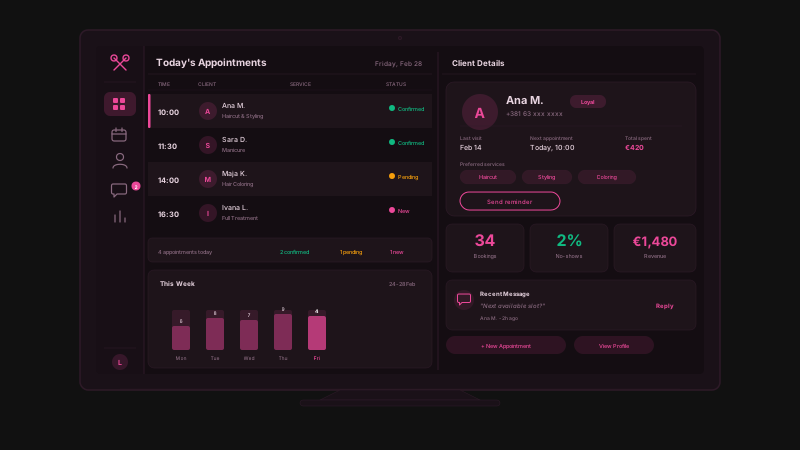
In House Chef, a catering management platform; Soccer Club Tracker, a finance tool for sports clubs; and Lux Beauty, an AI booking assistant that handles enquiries and schedules appointments.
 MVP + AI
Lux Beauty
An AI booking assistant for a beauty salon that handles appointment scheduling, sends reminders, and brings back lapsed clients — all via Instagram and WhatsApp.
View Case Study →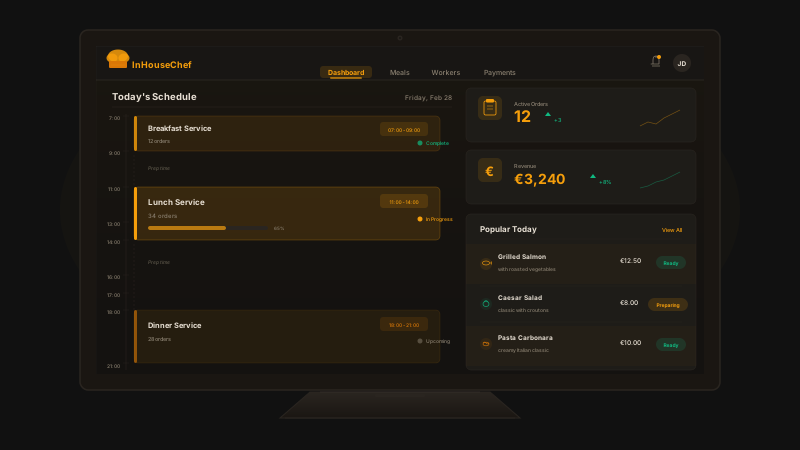 MVP
MVPIn House Chef
A catering management platform that eliminated food waste, streamlined worker payments, and automated weekly meal planning for in-house restaurant operations.
View Case Study →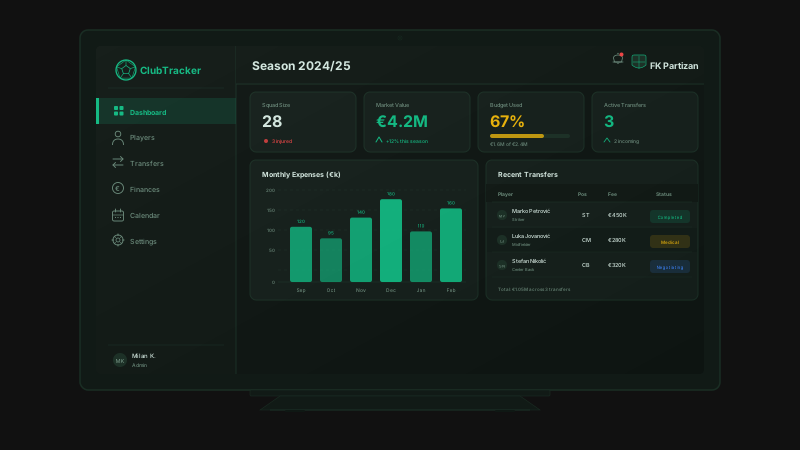 MVP
MVPSoccer Club Tracker
A financial tracking tool for soccer clubs that consolidates season expenses, player sale income, and accounting into one clear dashboard — replacing scattered spreadsheets.
View Case Study →